



“Send a proposal, we will take a look.”
You assemble a PDF: a cover, the company history, a mission, advantages, photographs of the team. It comes out looking solid. Only the answer to “what are you offering, and how much does it cost?” is still a scroll away.
I would start with why the client opened this file at all. Say you have already discussed the task. Now they need to understand the terms, compare them with other options, and possibly show the proposal to a manager.
I want a proposal that can be forwarded to a colleague without a five-minute voice message explaining where to look for the main point.
What a person should see at the start
- Which task the proposal was prepared for.
- What exactly you offer to do or to supply.
- What is included in the cost, and what the limits are.
- How much it costs, and what the timing depends on.
- What needs to be done in order to move on to the work.
Every detail does not have to be squeezed onto the first page. At the start, a clear overview is needed. Further on, the calculation, the stages, and the terms can be opened up.
Imagine two documents with the same offer. The first begins with a story about the contractor. The second explains at once what the client will get. The difference is visible before the small text is read.
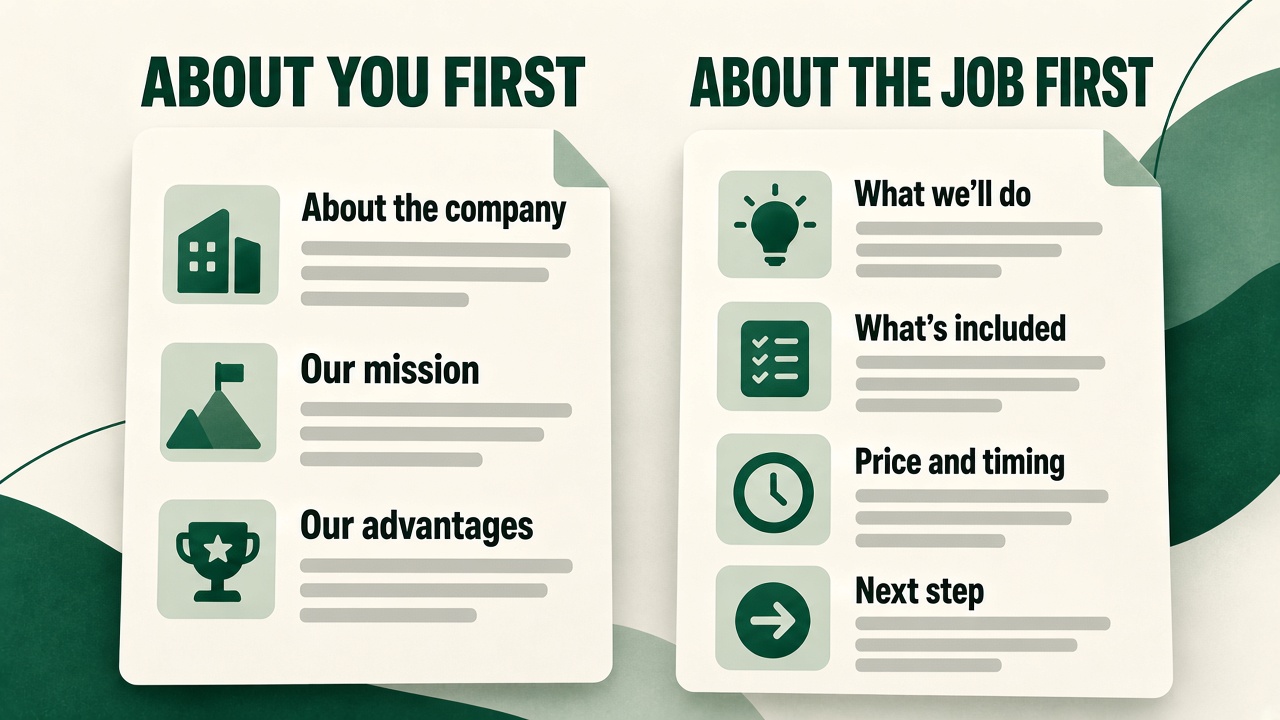
The same service can be described in different ways
Take a fictional studio that a café commissioned to design a menu. The example below shows only a description of the work, not a full commercial proposal.
General words
“We offer full design support for your venue. We create unique solutions that take the individual features of the business into account.”
To the point
“We will design a printed menu for the café from your list of dishes and prices. We will prepare the layout, agree the design, and hand over a print file that meets the requirements of the print shop you chose. Printing and photography of the dishes are not included in the proposal.”
The second version already has a subject for the conversation. But before a real proposal is sent, the size of the menu, the number of versions and revisions, the price, and the timing need to be clarified. Otherwise, different expectations will remain behind clear words.
For example, the client may assume that photographs and texts are included in the work, while the contractor expects them from the client. It is better to notice this before the project starts.
Put the price next to what is being paid for
If the cost sits at the end of the file, and the scope of work is scattered across other pages, the person has to assemble the proposal on their own.
I would place the amount next to a short list of the work. Separately, mark additional expenses, the payment order, and how long the calculation remains valid, if it is limited. The timing is worth explaining too: which event it is counted from, and which approvals are needed from the client.
If there is not enough data for a final price, say so. Explain what else needs to be known in order to calculate it. A preliminary estimate should not be presented as if it were already an agreed final sum.
Design helps find the answer
- Headings name the contents: “Scope of work,” “Cost,” “Timing,” and not “Your path to success.”
- Important terms are noticeable without a search through small notes.
- Examples of work relate to the client’s task. A few suitable ones are usually more useful than the whole collection in a row.
- On a phone, the main points can be read without constant zooming.
- At the end there is a specific next step and a contact for the reply.
Check the document before you send it
Open the file on a phone and imagine that yesterday’s conversation never happened. Is it clear who this proposal is for, what is included in the work, and how much it costs? Can the timing be made sense of? Is it clear whom to reply to, and with what?
Ask a colleague to find these details without hints. If you have to explain where to look, the structure is worth correcting.
Instead of a closing “We will be glad to work together,” you can write more specifically: “If the scope of work fits, reply to this message. We will discuss the start date and prepare a contract.” Use that wording only if that is actually how your next step works.
I would start the design of a commercial proposal with the order of the information. When the task, the scope of work, and the terms are clear, it is much easier to choose what to highlight, where to show an example, and which pages are needed at all.
If you want to design a proposal for your business, press “Message me on Telegram” on the site. Tell me what you sell and who you send the document to. If a current version already exists, attach it to the message.